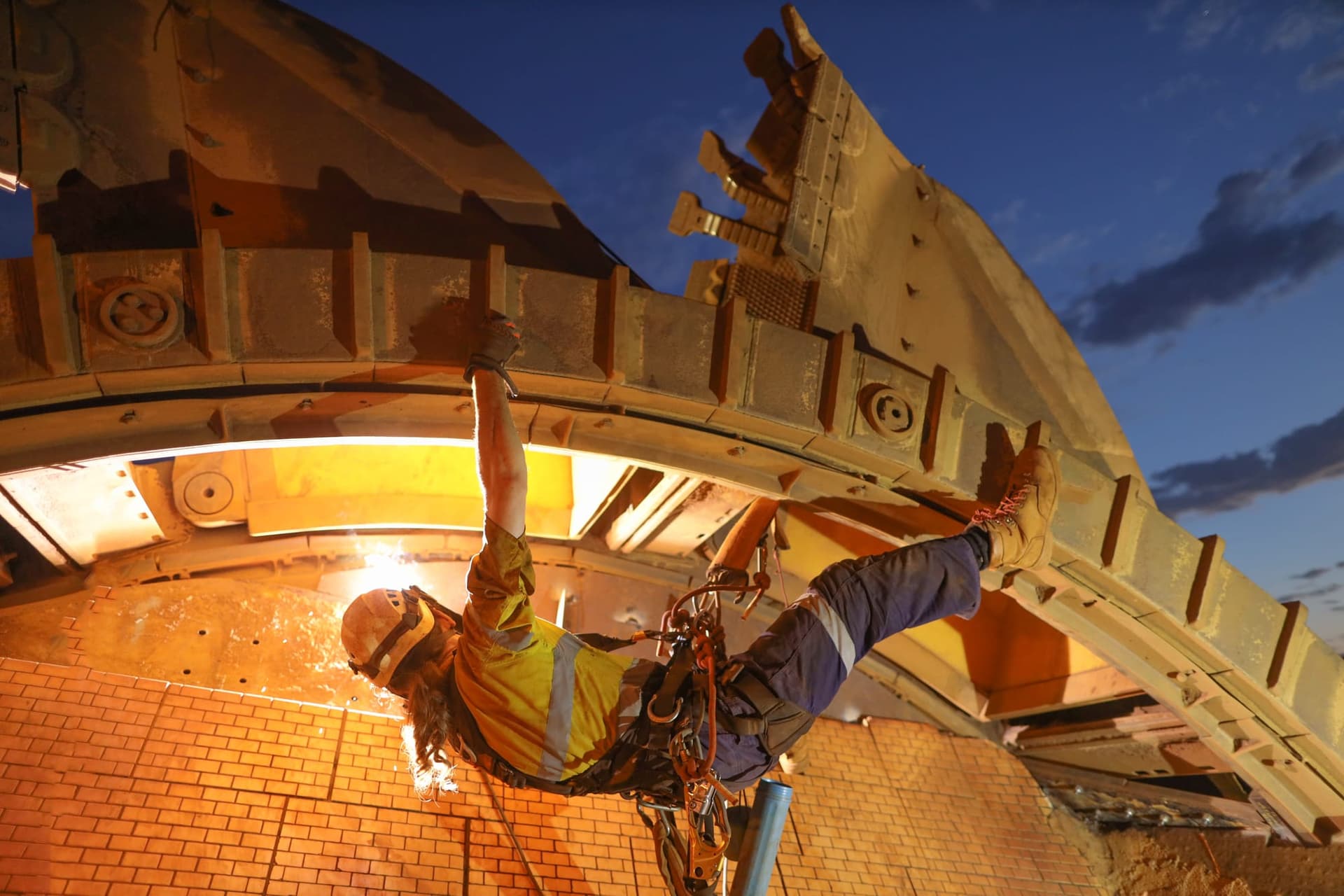
Welding on a construction site is a different beast to welding in a workshop. You are dealing with wind, dust, rain, awkward positions, and the reality that the thing you are welding is usually a 20-tonne machine that cannot be moved. Mobile welding is not about convenience. For most construction and mining projects, it is the only practical option.
At Definitive Contracting, our team carries out onsite welding and fabrication across Sydney and the Gold Coast every week. Bucket repairs, structural modifications, custom brackets, wear plate replacement, pipeline work. Here is a straightforward guide to what mobile welding involves on a modern construction site, including the processes we use, safety requirements, and what to expect when you book a job.
Welding Processes Used on Construction Sites
Not all welding is the same, and different situations call for different processes. Here are the four main types we use in the field and when each one applies:
MIG Welding (GMAW)
MIG is the workhorse of construction site welding. It uses a continuous wire feed and shielding gas to produce clean, strong welds relatively quickly. We use MIG for:
- General structural repairs
- Bucket and attachment rebuilds
- Fabrication of brackets, mounts, and supports
- Wear plate installation
MIG is fast and versatile, but it does not handle wind well. On exposed sites, we set up wind shields or switch to a different process.
Stick Welding (MMAW/SMAW)
Stick welding is the old reliable of field welding. It handles wind, rain, dirty steel, and rusty material better than any other process. The trade-off is that it is slower and produces more spatter. We use stick welding for:
- Heavy structural work in exposed conditions
- Repairs on dirty or corroded steel where prep time is limited
- Field joints on pipelines and structural members
- Situations where MIG gas shielding is impractical
TIG Welding (GTAW)
TIG produces the highest quality welds with the best appearance. It is slower and more technique-dependent, so we reserve it for situations where weld quality or material type demands it:
- Stainless steel work (handrails, tanks, food-grade equipment)
- Aluminium fabrication
- Precision repairs where heat input needs to be carefully controlled
- Thin-wall tubing and pipe work
Flux-Core Welding (FCAW)
Flux-core is essentially MIG welding without the external shielding gas. The flux in the wire creates its own gas shield, making it ideal for outdoor work in windy conditions. It also has better penetration on thicker materials. We use flux-core for:
- Heavy wear plate and liner installation
- Structural repairs in windy or exposed locations
- Hard-facing and wear-resistant overlays on crusher jaws, bucket edges, and ground-engaging tools
Safety Requirements: What Gets Done Before the Arc Strikes
Welding on a construction site carries serious safety obligations. This is not optional paperwork. It is the difference between going home safe and ending up in hospital, or worse. Here is what is involved:
Hot Works Permits
Any welding, cutting, or grinding on a construction site requires a Hot Works Permit. This is a documented risk assessment that covers:
- Fire risks in the immediate area (within 10 metres and below the work area)
- Combustible materials that need to be removed or shielded
- Fire extinguisher placement and type (dry chemical minimum; CO2 for electrical areas)
- Fire watch requirements (a dedicated person monitoring for fires during and after welding, typically 30 minutes minimum)
- Emergency procedures specific to the welding location
Safe Work Method Statements (SWMS)
Every welding job on a construction site needs a SWMS. Our team carries pre-prepared SWMS for common welding tasks, which we customise for each site. These cover:
- Hazard identification specific to the task and location
- Control measures for each identified hazard
- PPE requirements (welding helmet, gloves, leathers, steel caps, safety glasses)
- Ventilation and fume extraction requirements
- Electrical safety (RCD protection, lead management)
Confined Space and Working at Heights
Some welding jobs are inside tanks, hoppers, or other confined spaces. Others are on elevated structures. Both situations require additional permits, rescue plans, and in some cases, additional qualified personnel on standby. Our team holds confined space and working at heights tickets, and we will not start a job if the safety requirements are not met. No exceptions.
Common Onsite Welding Jobs
Here is a rundown of the welding and fabrication work we carry out most frequently on construction sites:
Bucket and Attachment Repairs
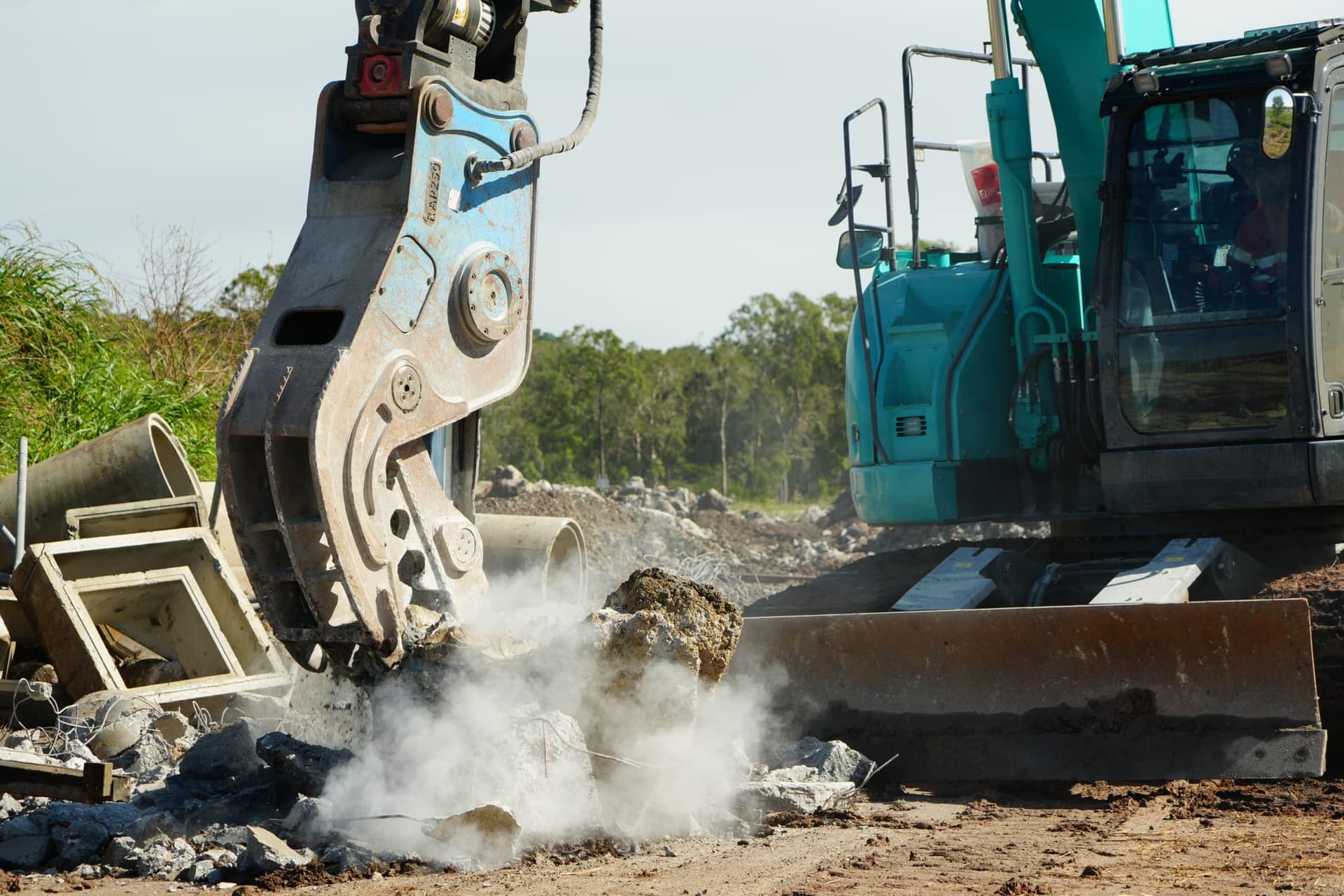
Excavator buckets take an absolute beating. Cracked side plates, worn cutting edges, bent teeth adapters, holed-out floors. A bucket rebuild on site can have the machine back digging in a few hours rather than days. We carry common wear parts (cutting edges, teeth, side cutters) and can hard-face critical wear areas to extend the life of the bucket significantly.
Structural Repairs and Modifications
Cracked chassis members on machinery, damaged ROPS (Roll Over Protective Structures), broken mounting points for attachments. Structural welding on heavy equipment requires an understanding of the loads involved and the correct welding procedures to maintain the integrity of the structure. Our welders are qualified to Australian Standard AS/NZS 1554 for structural steel welding.
Custom Fabrication
Sometimes you need something that does not exist off the shelf. Custom mounting brackets, equipment guards, walkway platforms, ladder modifications, pipe supports. We can fabricate from drawings or work from a description and measurements on site. Common materials we work with include mild steel, high-tensile steel, bisalloy wear plate, stainless steel, and aluminium.
Wear Plate and Hard-Facing
High-wear areas on crushers, screens, hoppers, and chutes need regular attention. We install and replace wear plates (typically Bisalloy 400 or 500 grade) and apply hard-facing overlays using specialist electrodes and flux-core wires. This preventative work extends the life of expensive components and reduces unplanned downtime.
Pipeline and Pressure Work
Water lines, air lines, hydraulic manifolds, and process piping. For any work on pressure-containing equipment, we follow AS 4041 (Pressure Piping) and ensure all welds are completed by appropriately qualified welders.
What to Expect When You Book a Mobile Welding Job
Here is the typical process from enquiry to completion:
- Assessment: You tell us what needs doing. Photos are helpful. We will ask about the material type, thickness, and what loads or conditions the repair will see in service.
- Quote: We provide a fixed-price quote where possible, or an hourly estimate for variable-scope work. No hidden charges.
- Scheduling: We confirm a date and time. For urgent repairs, we can often mobilise same day.
- Site setup: Our team arrives with all equipment, completes the Hot Works Permit and SWMS, and sets up the welding area.
- Execution: The welding or fabrication work is completed to the agreed specification.
- Handover: We clean up, provide photos of completed work, and walk you through what was done.
Qualifications and Standards
All Definitive Contracting welders hold current qualifications to AS/NZS 1554 (Structural Steel Welding) and AS/NZS ISO 9606 (Welder Qualification Testing). Our team also holds:
- White Cards (General Construction Induction)
- Confined Space Entry certificates
- Working at Heights certificates
- First Aid certificates
- Relevant state trade licences
We carry public liability insurance and can provide evidence of insurances and qualifications for site inductions and contractor pre-qualification.
Get a Quote
Whether it is a cracked bucket that needs fixing today or a planned fabrication job for next month, get in touch. Call us on 0401 343 691 (Sydney) or 0401 343 691 (Gold Coast), or head to our contact page to send through the details.